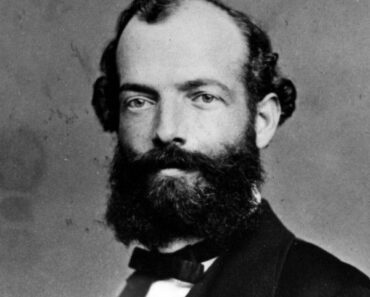
Gustav Kirchhoff was a German physicist. He is mostly known for his laws on the flow of electric current and Spectroscopy. He invented the term black-body radiation and his work in the field of science is considered fundamental to the advancement of quantum mechanics.
Wiki/Biography
Gustav Kirchhoff was born on Friday, 12 March 1824 (age 63 years; at the time of death), in Königsberg, Prussia. His zodiac sign is Pisces. He started schooling with his brothers at Kneiphofische High School, Königsberg. He earned a diploma in 1842. He completed his graduation from Albertus University of Königsberg in 1847. At Albertus University, Friedrich Julius Richelot was the professor of mathematics and Franz Ernst Neumann was the primary research mentor of Gustav Kirchhoff. From 1843 to 1846, Kirchhoff attended the mathematics-physics seminar, set up by Neumann-Jacobi in the university.
Physical Appearance
Height (approx.): 5′ 6″
Hair Colour: Salt and Pepper
Eye Colour: Black
Family
Parents & Siblings
Gustav Kirchhoff’s father, Carl Friedrich Kirchhoff, was a judge at the Royal East Prussian state court in Königsberg. He was appointed as a judge in 1823. In 1845, his father was titled as counsel of justice. His mother was Juliane Johanne Henriette von Wittke. They got married in 1819. Kirchhoff had two older brothers - Carl Johann, and Otto Friedrich.
Wife & Children
Gustav Kirchhoff got married to Clara Richelot in 1847. Her father, Friedrich Julius Richelot, was the mathematics professor of Kirchhoff. They had two sons and two daughters. His wife died in 1869. After the death of his wife, he got married to Benovefa Karolina Sopie Luise Brömmel in 1872.
Signature/Autograph
Career
Academic Work
Gustav Kirchhoff worked in an unpaid post as a professor of mathematical physics at the University of Berlin from 1848 to 1850. He then moved to Breslau, Prussia (now Wroclaw, Poland) and worked as a professor of physics at the University of Breslau (now the University of Wrocław, Poland). He met Robert Bunsen at the University of Breslau in 1851. He received an offer letter from Heidelberg University in 1854 and moved there to work as a professor. He worked at Heidelberg University from 1854 to 1874 and it was the most active period of his life. He worked in collaboration with Robert Bunsen during this period and made significant contributions to the development of science.
Scientific Work
Gustav Kirchhoff made significant contributions to the development of science. He created certain laws that helped to modernize science and create opportunities for growth. Kirchhoff also studied the term black-body radiation. He invented this term in 1862. He also made some contributions to the field of optics.
Kirchhoff’s Circuit Laws
Gustav Kirchhoff created circuit laws in 1845 at the age of 21. He created this law while studying and published his first paper in Annalen der Physik und Chemie in 1845 which included the Current law and Voltage law. Kirchhoff stated that it is a continuation of the Ohm’s law.
Kirchhoff’s current law
The total current entering a junction or a node is equal to the charge leaving the node as no charge is lost.
Kirchhoff’s Voltage Law
The voltage around a loop equals the sum of every voltage drop in the same loop for any closed network and equals zero.
Kirchhoff’s law of thermal radiation
This law states that, at a given temperature, the emissivity of a substance is equal to the coefficient of absorption.
Laws of Spectroscopy
Gustav Kirchhoff worked in collaboration with Robert Bunsen to develop these laws:
- Incandescent solids, liquids, or dense gases which light up after they are heated emit a continuous spectrum of light and they emit light at all wavelengths.
- A hot, low-density gas produces an emission-line spectrum such that the gas emits light at specific, discrete wavelengths, which can be seen as bright lines in an otherwise dark spectrum.
- A continuous spectrum traversing through a cooler, low-density gas produces an absorption-line spectrum such that the gas absorbs light at specific, discrete wavelengths, which can be seen as dark lines in an otherwise continuous spectrum.
Kirchhoff and Bunsen discovered cesium and rubidium through this experimentation. These laws helped advance research in thermal radiation and explain the sun’s spectrum.
Awards, Honours, Achievements
- In 1862, the Rumford medal
- In 1877, the Davy Medal
- In 1877, the Matteucci Medal
- In 1887, the Janssen Medal
- In 1864, member of the American Philosophical Society
- In 1884, a foreign member of the Royal Netherlands Academy of Arts and Sciences
- IEEE Circuits and Systems Society established the IEEE Gustav Robert Kirchhoff Award in 2003
Death
Gustav Kirchhoff died on 17 October 1887, reportedly due to cerebral congestion.
Facts/Trivia
- He retired from teaching in 1886 due to illness.
- Around 1869, Kirchhoff fell on a staircase and had to use a wheelchair for some time.
- In 1875, he accepted the chair of theoretical physics at the University of Berlin.
- Kirchhoff was very joyful and talkative in his childhood.
- In 1974, the German Democratic Republic issued a Postage stamp honouring Gustav Kirchhoff.