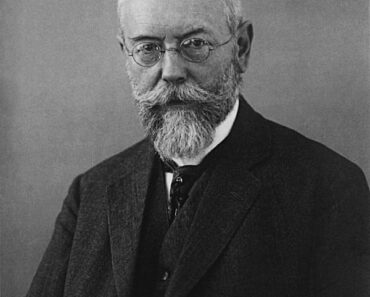
Wilhelm Conrad Röntgen was a German physicist and a mechanical engineer who discovered X-rays. He is considered the Father of Radiology and received the first Nobel Prize in physics in 1901 for his work. He died from carcinoma of the intestine on 10 February 1923.
Wiki/Biography
Wilhelm Röntgen was born on Thursday, 27 March 1845 (age 77 years; at the time of death) in Lennep, now called Remscheid-Lennep, in the Lower Rhine Province of Germany. His Zodiac sign is Aries. He grew up in Apeldoorn, Netherlands.

The house where Wilhelm Röntgen was born
He studied for fourteen years at Martinus Herrmann van Doorn, a private boarding school at Regentesselman, Netherlands. He left Apeldoorn and enrolled in the Utrecht Technical School on 27 December 1862. During this time, he stayed at Dr Jan Willem Gunning’s house, a well-known Chemist at 62 Nieugewracht, Utrecht. He was accused of creating a caricature of his professor, which was supposedly drawn by some other student and he was expelled from school in 1863. Later, he registered at the University of Utrecht to audit some courses. After hearing that they did not require a technical school diploma, he applied for admission to the Mechanical Technical Division of the Zurich Polytechnical School and got accepted.

Wilhelm Röntgen as a student
On 16 November 1865, he left for Zurich, where he lived in a house at 7 Seilergraben, Zurich until 1869. He received a degree in mechanical engineering on 6 August 1868. After graduation, he took courses with Dr. August Kundt and attended lectures by Rudolf Clausius at the University of Zurich. On 22 June 1869, Wilhelm Röntgen earned his doctorate in philosophy under Dr. August Kundt for his dissertation ‘Studies on gases.’
Family
Parents & Siblings
Wilhelm Röntgen’s father, Friedrich Conrad (1801-1884), was a local textile merchant and manufacturer of clothes. His mother, Constance Charlotte Frowein (1806-1888), was a member of an old Lennep family of Dutch heritage that had settled in Amsterdam. He was the only child of his parents.

Wilhelm Röntgen with his parents
Wife & Children
Wilhelm Röntgen got married to Anna Bertha Ludwig, daughter of Ludwig, owner of a local inn, on 19 January 1872 at his old Roentgen home in Apeldoorn. He earlier proposed to her on the day he received his degree in mechanical engineering in 1868. Anna Bertha was six years older than him at the time of marriage. The couple had no children but adopted Josephine Bertha Ludwig (then aged six), daughter of Anna Bertha Röntgen’s brother, Hans Ludwig, in 1887.

A photo of Bertha Roentgen and Josephine Bertha Ludwig
Religion/Religious Views
Wilhelm Röntgen followed Christianity. He was a member of the Dutch Reformed Church and was a Protestant Christian.
Signature/Autograph

Wilhelm Röntgen’s signature
Career
Academic Career
Wilhelm Röntgen went to Julius Maximilians University of Wurzburg, Germany with Professor Kundt as his assistant in 1870. Two years later he moved to Strasbourg and joined Kundt as his assistant when he was called to the Kaiser Wilhelms University of Strasbourg under German rule. On 13 March 1874, he passed the exams for privatdozent at the University of Strasbourg. At the age of 30, he was called by the Academy of Agriculture in Hohenheim in Württemberg for the position of professorship in physics and mathematics. He accepted the position as it came with benefits like German citizenship, a higher salary, and a civil service status. He returned to Strasbourg on 1 October 1876, when he was called for the chair for theoretical physics at the University of Strasbourg. He left Strasbourg for the position of full professor at Justus von Liebig University of Giessen on 1 April 1879. In 1888, he was offered the position of professor of physics and director of the Physical Institute at the University of Wurzburg, which he accepted. He produced seventeen important papers during his time at Wurzburg. In 1894, he was elected for the position of president of the Julius Maximilian University of Wurzburg for two years. He was called by the Bavarian government to the University of Munich in 1900; he accepted the offer and stayed there for the remainder of his life.
Discovery of the rays
In 1895, many great scientists like J. Plucker, J. W. Hittorf, C. F. Varley, E. Goldstein, Sir William Crookes, and H. Hertz were studying the properties of Cathode rays. Captivated by the studies, Wilhelm Röntgen started his experimental work on Cathode rays in October 1895. He started by assembling the best equipment needed for his experiments. The apparatus included a large Ruhmkorff induction coil, Deprez interrupter, Hittorf-Crookes tubes, Lenard tubes, and a Raps vacuum pump. On 8 November 1895 Röntgen discovered that if the discharge tube was encased in cardboard connected to a Ruhmkorff coil, and if he worked in a dark room, a continued fluorescence of a faint green cloud of flickering light waves moving in unison was visible on a small piece of paper painted with barium platinocyanide. He examined all kinds of objects over the weekend such as a set of weights, a coil of wire, a compass, the barrel of his shotgun, different types of wood and paper, and glass. The first human X-ray was recorded on 27 December 1895, which Wilhelm Röntgen performed on his wife’s hand. Shocked and struck after witnessing the X-ray, Anna Bertha said,
I have seen my death.”

X-ray of Anna Bertha’s hand taken in 1865 by Wilhelm Roentgen
He delivered his historic paper titled ‘On the new kind of rays’ to the Wurzburg Physical Medical Society on 28 December 1895.
Awards, Honours, Achievements
- Rumford Medal (1896)
- Matteucci Medal (1896)
- Elliott Cresson Medal (1897)
- Barnard Medal for Meritorious Service to Science (1900)
- Nobel Prize for Physics (1901)

Wilhelm Röntgen’s Nobel Prize, 1901
- On 30 November 1930, Arno Breker, a German architect dedicated a monument to Wilhelm Röntgen in his hometown.

A monument of Wilhelm Röntgen in Lennep by Arno Breker in 1930
- On 18 June 1932, the Deutsches Roentgen Museum was opened in his honour in Lennep.
- An X-ray monument created by the artist Erich Fritz Reuter was established in 1962 in Giessen to honour Wilhelm Conrad Röntgen.

X-ray monument established in 1962 in honour of Wilhelm Conrad Röntgen, in Giessen
Legacy
- The International Union of Pure and Applied Chemistry (IUPAC) named an element after Wilhelm Röntgen in 2004. The element 111 was named roentgenium.
- 6401 Röntgen, a minor planet is named after him.
- Röntgen Peak in Antarctica is named after him.
- World Radiography Day is celebrated on 8 November every year, introduced by the European Society of Radiology, the Radiological Society of North America, and the American College of Radiology in honour of the anniversary of the discovery of rays.
- A street in the town of Apeldoorn is named after him.
- A street at CERN, Geneva, Switzerland was officially registered as ‘Route Röntgen’ in 2013.
Death
In early 1923, he was diagnosed with terminal colon cancer, and he passed away on 10 February 1923. He was cremated 3 days later, and his ashes were buried in the Roentgen plot in Giessen, Hesse, Germany on 10 November 1923.

the grave of Wilhelm Röntgen in Giessen, Germany
Facts/Trivia
- Wilhelm Röntgen’s family moved to Apeldoorn, Holland when he was 3 years old, on 13 May 1848 because of the political unrest in Prussia at the time.
- He loved nature and often went on frequent hikes while he was in Zurich in 1865.
- Before marriage, Anna Bertha went to Apeldoorn to learn German cooking and housekeeping from Wilhelm Röntgen’s family.
- He enjoyed hunting and had a hunting lodge in Weilheim, where he spent a lot of time with his friends.

Wilhelm Röntgen in Weilheim
- The German Roentgen Society placed a plaque on the Roentgen home on 27 March 1920. It translates, “In this house, the discoverer of the rays that were named for him, Wilhelm Conrad Roentgen, was born on 27 March 1845. His home town declared him an honorary citizen in 1896.”

Plaque on Roentgen home, 7 Seilergraben, Zurich, Switzerland
- Wilhelm Röntgen, in his will, declared that the equipment he used during his rays discovery should be given to the famous Deutsches Museum in Munich.
- After the discovery of the rays, he was awarded an honorary Doctor of Medicine from the University of Wurzburg.
- In 1897, he was elected as a member of the American Philosophical Society and in 1907 he became a foreign member of the Royal Netherlands Academy of Arts and Sciences.
- Wilhelm Röntgen wanted the world to benefit from his discoveries, hence he refused to patent his discovery of X-rays.
- He published fifteen important papers in 1876 and was regarded as a rising star in his field.
- After winning the Nobel Prize in 1901, Röntgen donated the prize money to the University of Wurzburg.
- He presented his work to Emperor Wilhelm II in Berlin on 13 January 1896.