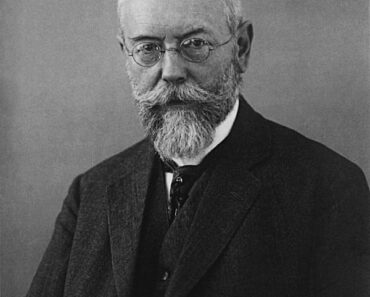
Freidrich August Kekule (1829-1896) was a German chemist known as one of the founding fathers of organic chemistry. His most prominent discovery was the structure of benzene, in 1865. He died on 13 July 1896 in Bonn, Germany.
Wiki/Biography
August Kekule was born on Monday, 7 September 1829 (age 66 years; at the time of death) in Darmstadt, Neckarstrasse 19, Germany. His Zodiac sign is Virgo. From 1835 to 1847, he was a pupil at the Ludwig-Georgs-Gymnasium, Darmstadt run by Heinrich Schmitz. He left the gymnasium in 1847 with a distinguished leaving certificate and joined the University of Giessen as his family intended him to be an architect.
During his second semester, he was inspired by his fellow Hessian Liebig’s chemistry course and decided to be a chemist. Kekule’s family was reluctant to his new plan at first. After that, he attended a semester at the Polytechnic in Darmstadt, in 1848. Later, he spent the winter semester of 1849 to study chemistry at Giessen. He participated in research on the composition of gluten and wheat bran while working in Liebig’s laboratory. In 1851, August Kekule went to Paris and took courses in Physics and Chemistry, where he became a student of Charles Gerhardt. He was awarded the degree of Dr. Phil. for an experimental thesis “Uber die Amyloxydschwefelsaure und einige ihrer Salze” (About amyloxysulfuric acid and some of its salts) completed under the supervision of Heinrich Will in 1852.
Family
Parents & Siblings
August Kekule’s father, Ludwig Karl Emil Kekulk (1773-1847), was a chief war council. His mother’s name is Eva Maria Margaretha Kekule (1793-1852). He had three brothers named Karl Ludwig Kekule, Emil Phillip Kekule, and Friedrich Ernst Carl Kekule, and two sisters named Maria Wilhelmine Knoblauch, and Johanette Susanne Phillipine Weis. Kekule grew up in an upper-middle-class family.
Wife & Children
August Kekule got married to Stephanie, the youngest daughter of his close friend George William Drory on 24 June 1862; Kekule was 32 years old, while Stephanie was 19 years old at the time of marriage. The couple was blessed with a son named Stephan Karl Kekule in May 1863. Stephanie Kekule died after two days of giving birth to her son. Later, he got married to Luise Högel, his housekeeper, in 1876. The couple had a son, Fritz, and two daughters, Louise, and Auguste.
Religion
He was a Protestant Christian and followed Christianity. ((Royal Society of Chemistry))
Career
Academic Career
He worked as a private assistant to A. von Planta, a former student of Liebig, at Reichenau Castle near Chur in 1852. Later, he assisted Professor J. Stenhouse at St. Bartholomew’s Hospital, London until 1855. While in London, he met A. W. Williamson, another former student of Liebig who worked significantly on the synthesis of ether. The theory of valency was formulated during his experiments on a series of sulfur-containing organic acids and joint studies with Williamson. August Kekule once talked about working under eminent chemists of the era and said,
I became a scholar of Dumas, Gerhardt, and Williamson; I no longer belonged to any one school”
In 1855, he went to Heidelberg to work as a Privatdozent under Robert Wilhelm Bunsen. He started teaching organic chemistry at the University of Heidelberg in 1856. He published two fundamental papers on the theory of valency in 1857 and 1858. He was appointed professor of chemistry at the University of Ghent, Belgium, in 1858, at the age of 29, where he was promised the introduction of practical chemistry into the curriculum and a laboratory for teaching and research work.
He published his first instalment of Lehrbuch der organischen Chemie (“Textbook of Organic Chemistry”) in June 1859 while devoting his time to further formulating the structural theory documented in his four-volume textbooks. Kekule proposed the formula of benzene in 1865.
After spending nine years at Ghent, he accepted the offer of the chair of chemistry at the University of Bonn in 1867. In 1875, he was called at the University of Munich as successor to J. von Liebig, but he declined the offer. He worked as a chancellor of the University of Bonn from 1877 to 1878.
Significant theories
Theory of structure
In 1890, at the Benzene Festival of the German Chemical Society in Berlin, August Kekule recalled his dream. He explained how he envisioned dancing atoms and molecules before his eyes when he was on the last Omnibus through the empty streets in London, in the summer of 1855. This resulted in the discovery of his theory of valence and the theory of structure.
Benzene theory
He explained the second case with Benzene theory at the Benzene festival in 1890. During his time in Ghent, in 1862, one day, he fell asleep in front of his fireplace and had a daydream of atoms dancing before his eyes and snake figures holding their own tail. He spent the rest of the night working on the consequences of this hypothesis.
Structure of a benzene ring from August Kekulé’s Chemie Der Benzolderivate Oder Der Aromatischen Substanzen, 1867
Awards, Honours, Achievements
- Copley Medal (1885)
- He was awarded an honorary M.D. on the inaugural of the new chemical institute at the University of Bonn for his contributions to theoretical chemistry, in 1868.
- The Huyghens Medal (1889)
- The Bavarian “Maximilian-Orden fur Kunst und Wissenschaft” (1890)
- Kronenorden 11. Klasse (1890)
- He was honoured with the Prussian title of nobility by Kaiser Wilhelm II of Germany in 1895, and he adopted the surname Kekule von Stradonitz.
- His statue was unveiled in front of the Chemical Institute at the University of Bonn in 1903.
Note: Kekule was bestowed with many honours and accolades, including honorary stamps, for his contribution to the field of chemistry.
Death
August Kekule suffered an attack of measles illness in 1876, which affected his health seriously for the remainder of his life, and he died on 13 July 1896 (age 66 years) in Bonn, Germany. He was buried in the Poppelsdorf Cemetery, Bonn.
Facts/Trivia
- He showed a remarkable talent for drawing and mathematical abilities as a child.
- Kekulé belonged to an old Bohemian noble family, Kekule ze Stradonič Stradonice, now in the Czech Republic.
- After the death of his first wife, Stephanie, in 1863, he was not able to continue his creative work for the following months. He returned to his research in 1864.
- The first two Nobel Prize winners in chemistry were August Kekule’s students, Jacobus H. Van’t Hoff (1901) and Emil Fischer (1902).
- August Kekule installed a private laboratory, where he experimented on the chemical constitution fulminate of mercury and a lecture room on the first two floors of a house in Heidelberg.
- He organized the first international congress on chemistry at Karlsruhe from September 3 to 5, 1860.