Kalpana Chawla (1962-2003) was an Indian American astronaut and aerospace engineer who is best known for being the first woman of Indian origin to fly to space. On 1 February 2003, the Space Shuttle Columbia broke apart when the shuttle was trying to re-enter into the Earth’s atmosphere, which led to her untimely demise.
Wiki/Biography
Kalpana Chawla was born on Tuesday, 17 March 1962 (age 40 years; at the time of death) in Karnal, Haryana. Her Zodiac sign is Pisces. She grew up in a Punjabi Hindu family in Karnal.

Kalpana Chawla’s childhood photo
Chawla used to visit the local flying club with her father and had shown interest in aviation since childhood. She completed her schooling at Tagore Baal Niketan Senior Secondary School in 1976. She later attended Dyal Singh College and DAV College for Women, both in Karnal, India. Later on, she earned a Bachelor of Science degree in aeronautical engineering from Punjab Engineering College, India, in 1982. After that, she moved to the United States, where she received a Master of Science degree in aerospace engineering from the University of Texas in 1984. In 1988, Kalpana Chawla earned a Doctorate of Philosophy in aerospace engineering from the University of Colorado.
Physical Appearance
Height (approx.): 5′ 4″
Hair Colour: Black
Eye Colour: Dark Brown

Family & Caste
Kalpana Chawla belonged to an Arora family in Karnal.
Parents & Siblings
Kalpana Chawla’s father, Banarsi Lal Chawla, was a leading businessman and owned a Tire factory. Her father passed away at the age of 90. ((The Indian Express)) Her mother, Sanyogita Chawla, was a homemaker, who wanted a boy as her last child. Chawla was the youngest child and had three siblings, one brother named Sanjay Chawla, and two sisters named Deepa Chawla, and Sunita Chawla.

Clockwise – Kalpana Chawla (sitting extreme right) with her father, B S Chawla, sister Deepa, sister-in-law Anju, and elder sister Sunita
Husband & Children
Kalpana Chawla got married to Jean Pierre Harrison at the age of 21 on 2 December 1983 in a private ceremony. He is a freelance flight instructor and an Aerospace engineer by profession. The couple had no children.
Relationships/Affairs
Kalpana Chawla met Jean Pierre Harrison during her master’s degree in Texas. He was working on earning a professional pilot qualification at that time. They both became close friends and fell in love later.

Kalpana Chawla with Jean Pierre Harrison
Religion
She followed Hinduism.
Signature/Autograph

Kalpana Chawla’s signature on an STS-87 launch cover
Citizenship
She became a United States citizen on 10 April 1991.
Career
NASA
After completing her Doctorate in 1988, Kalpana Chawla started work at NASA Ames Research Center in the area of powered-lift computational fluid dynamics, where she supported research in mapping flow solvers to parallel computers, and testing these solvers by carrying out powered lift computations. She joined Ovreset Methods Inc., Los Altos, California, as Vice President and Research Scientist in 1993 to form a team with other researchers specializing in the simulation of moving multiple body problems. In 1991, she applied for the NASA Astronaut Corps. Kalpana Chawla was selected by NASA in December 1994 and reported to the Johnson Space Center in March 1995 as an astronaut candidate in the 15th Group of Astronauts. In November 1996, Kalpana Chawla was assigned as mission specialist and prime robotic arm operator on STS-87. She flew on two Space Shuttle missions STS-87 (1997) and STS-107 (2003), logging 30 days, 14 hours, and 54 minutes in space.
Space flight experience
Space Shuttle Columbia flight STS-87
Kalpana Chawla’s first mission was STS-87 Columbia (19 November 1997 to 5 December 1997) at the age of 35. It was focused on studying how the weightless environment of space affects various physical processes, and on observations of the Sun’s outer atmospheric layers. Two of the crew members (Winston Scott and Takao Doi) performed spacewalks during this mission. STS-87 traveled 6.5 million miles in 376 hours and 34 minutes.

Kalpana Chawla (extreme left) with STS-87 crew members
In an exclusive interview after the successful mission, she said,
If you want to do something, what does it matter where you are ranked? Nor does being a woman make a difference.
Space Shuttle Columbia flight STS-107
STS-107 Columbia (16 January 2003-1 February 2003) was the first shuttle mission in 2003, and this mission marked the 28th flight of the Space Shuttle Orbiter Columbia. Kalpana Chawla was designated as the mission specialist. The 16-day mission ended unexpectedly when the Columbia Space Shuttle disintegrated while it was trying to re-enter into the Earth’s atmosphere on 1 February 2003.

The crew members of STS-107
Awards & Honours
- NASA Space Flight Medal
- NASA Distinguished Service Medal
- Defense Distinguished Service Medal (DDSM)
- Congressional Space Medal of Honor
Note: She received these awards posthumously.
Legacy
Places
- 74th Street in the “Little India” of Jackson Heights, Queens, New York City, New York, United States, has been renamed “Kalpana Chawla Way” in her honor.
- A street is named Kalpana Chawla Street in Rayon Nagar in Sirumugai, after her name.
- The Government of Haryana established the Kalpana Chawla Planetarium in Jyotisar, Kurukshetra.
- A military housing development at Naval Air Station Patuxent River, Maryland is named Columbia Colony and also has a street named after her, called the Chawla Way.
- Kalpana Chawla Government Medical College (KCGMC) in Karnal, Haryana, India is named after her.
Awards and Scholarships
- The Government of Karnataka instituted the Kalpana Chawla Award to recognize young women scientists, in 2004.
- The Kalpana Chawla Outstanding Recent Alumni Award was renamed after Chawla at the University of Colorado, which has been given since 1983.
- At Punjab Engineering College, an award of INR twenty-five thousand, a medal, and a certificate is instituted for the best student in the Aeronautical Engineering department.
Buildings
- The University of Texas at Arlington opened a dormitory after her name in 2004.
- The Punjab Engineering College, India, named a girl’s hostel after her name.
- The Indian Institute of Technology, Kharagpur, named the Kalpana Chawla Space Technology Cell in honor of her memory.
- A hall at Florida Institute of Technology’s student apartment complexes, Columbia Village Suites, is named after her.
- A girls’ hostel block at Delhi Technological University is named after her.
- The National Institute of Technology, Kurukshetra named a girls’ hostel after Chawla.
- The National Institute of Technology, Bhopal has a girls’ hostel named Kalpana Chawla Bhawan.
Space
- The fourteenth contracted Northrop Grumman Cygnus spacecraft mission, which delivered supplies to the ISS was named after her.
- Asteroid 51826 Kalpana Chawla is named after her.
- A lunar crater named Chawla is dedicated to her.
- In her memory, Indian Prime Minister Atal Bihari Vajpayee renamed the weather satellite Metstat as Kalpana-1, which was launched in 2002.
- NASA dedicated a supercomputer to Kalpana Chawla.
- The NASA Mars Exploration Rover mission named one of the hills out of Columbia Hills, ‘Chawla Hill’ after her.
- A satellite named after Chawla was launched into space as part of the Satellogic Aleph-1 constellation.
Death
Kalpana Chawla died in the Space Shuttle Columbia disaster alongside six other crew members on 1 February 2003 (age 40), when Columbia Space Shuttle disintegrated 16 minutes before its scheduled landing over Texas during its re-entry into the Earth’s atmosphere. Her remains were cremated and scattered at Zion National Park.
Facts/Trivia
- Chawla was a strict vegetarian, in observance of her Hindu faith.
- Kalpana Chawla’s parents called her by the nickname Montu and she hadn’t been formally named until she started school. She picked her name when she entered school.
- Kalpana Chawla enjoyed flying, birdwatching, hiking, backpacking, and reading.
- She learned Karate while studying at Punjab Engineering College in Chandigarh, and eventually became a black belt.
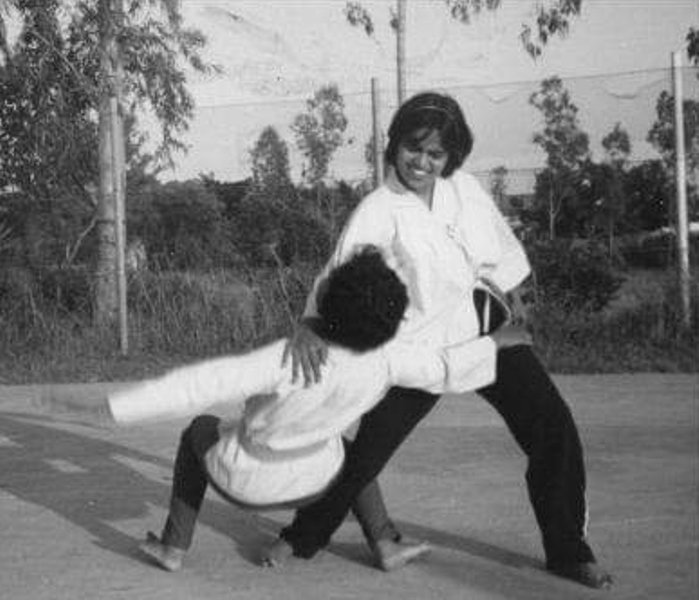
Kalpana Chawla played Karate
- The University of Texas dedicated a Kalpana Chawla memorial at the Arlington College of Engineering in 2010.
- In 2011, her husband, Jean Pierre Harrison, visited “Punjab Engineering College,” where he released the biography of Kalpana Chawla titled “The Edge of Time” along with her sister-in-law Anjali Chawla; Kalpana studied at PEC University of Technology. ((The Times of India))
- After the demise of her father, his body was donated to Kalpana Chawla Government Medical College (KCGMC) for medical research as per his wishes.
- Chawla’s family were refugees from Pakistan who settled in Karnal after the partition of India, in 1947.
- She actively took part in everything at school, from athletics to dance to science modeling. Also, she had a brilliant academic record.

Kalpana Chawla’s childhood image
- On her second mission STS-107 (16 January 2003-1 February 2003), she carried two dozen CDs including ones of Ravi Shankar, Abida Parveen, and Deep Purple.
- Her sole mentor was her brother, Sanjay, and they both shared the same dream. His dream to become a commercial pilot was shattered when his medical reports were not up to the mark.
- Kalpana Chawla and her husband moved to Boulder after marriage where she completed her Ph.D. During that time, she also earned her Private Pilot License
- In completing her first mission STS-87, Chawla traveled 6.5 million miles in 252 orbits of the Earth and logged 376 hours and 34 minutes in space.
- She was the second Indian who flew on a Soviet mission, following cosmonaut Rakesh Sharma.